Whether you are an individual changing your home, a company needing to archive documents, or simply looking for a suitable storage location, Is storage an ideal solution?
Discover its principle, how it works, and compare advantages and disadvantages to make your choice in terms of storage solution.
Summary
What is a storage unit?

The storage unit is a secure storage solution offered by a specialized company or a transport company.
It allows you to store furniture, boxes and personal effects in secure containers, placed in a storage warehouse under surveillance.
Unlike the self-storage box, you do not have free and permanent access : the deposit and collection of goods is by appointment, with the assistance of the service provider.
Traditional furniture storage is therefore ideal if you are looking for a safe, supervised and long-lasting solution, particularly in the event of moving abroad, prolonged work or lack of lasting space.
How does renting a traditional storage unit work?
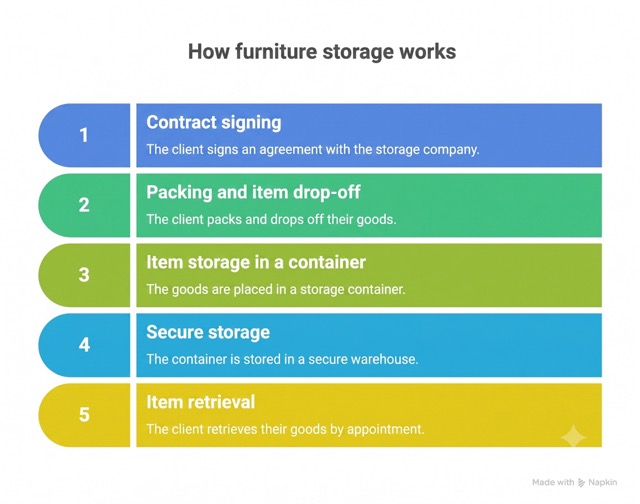
Please note: do you need to collect a specific sofa or paper? You call 48 hours before, the team takes out the container, and you have access to your belongings under control.
What rental duration for a traditional storage unit?
Traditional furniture storage offers long-term flexibility, but is more oriented towards the medium-long term :
- Minimum duration: generally one month.
- Long-term rental: often favored by individuals traveling abroad or by companies to store archives.
- Indefinite duration: some providers allow you to extend without limit.
Obviously, the longer the duration, the lower the monthly rate.
What goods can be stored in a storage unit?
It can be stored practically everything that makes up a home :
- Heavy furniture : beds, wardrobes, sofas, sideboards.
- Household appliances and fragile objects : washing machine, upright piano, mirrors, paintings.
- Boxes of personal effects : clothes, dishes, books.
- Professional goods : archives, tools, seasonal equipment.
Prohibited items: flammable products, perishable foods, illegal or dangerous substances, live animals.
How are goods in storage secured?
Safety is the heart of value a storage unit: closed and sealed box impossible to open without the service provider, warehouse monitored 24/7 (cameras, fire/intrusion alarms) access strictly supervised by staff compulsory insurance covering theft, fire, water damage, etc.
This ensures that your belongings remain intact and protected throughout storage.
The different types of storage

Furniture storage, self storage, storage box, co-storage, specialized storage…
It is sometimes difficult to to sort.
Traditional storage unit vs self-storage box: what’s the difference?
Even if these two types of storage are sometimes confused, they meet different needs:
| Features | Traditional storage | Self-storage box |
|---|---|---|
| Access | By appointment | Free 7 days a week (extended hours) |
| Kind | Sealed wooden crate or metal container | Individual box with key/code |
| Management | By the provider | By the customer |
| Ideal for | Long term, maximum security | Flexible access, frequent visits |
Example of use: a student who comes back every weekend to pick up business will prefer the Self-storage. On the other hand, a couple who goes abroad for 2 years will opt for furniture storage.
Specialized storage
In addition to the classic storage unit for storing furniture and boxes, certain specialized structures offer storage possibilities adapted to more specific needs. These options meet the expectations of individuals, companies or regulated professions.
Spaces dedicated to vehicles
Some storage centers offer containers or warehouses designed for classic or prestige cars, motorcycles and scooters, boats and jet-skis,
It is an ideal solution for those who lack space in a garage or wish to protect a vehicle during a move, work or a stay abroad.
Archival and document storage
Many professionals (lawyers, notaries, doctors, businesses) use storage to keep their documents with complete peace of mind, in spaces suitable for storing paper archives (air conditioning, protection against humidity).
Specialized professional storage
Some traditional storage units also offer tailor-made options for:
- Professional equipment (machines, tools, seasonal equipment).
- Non-perishable products (office furniture, event equipment, sports equipment).
- Buffer stock for companies lacking space in their premises.
- Personal effects of military personnel or expatriates during a long-term mission…
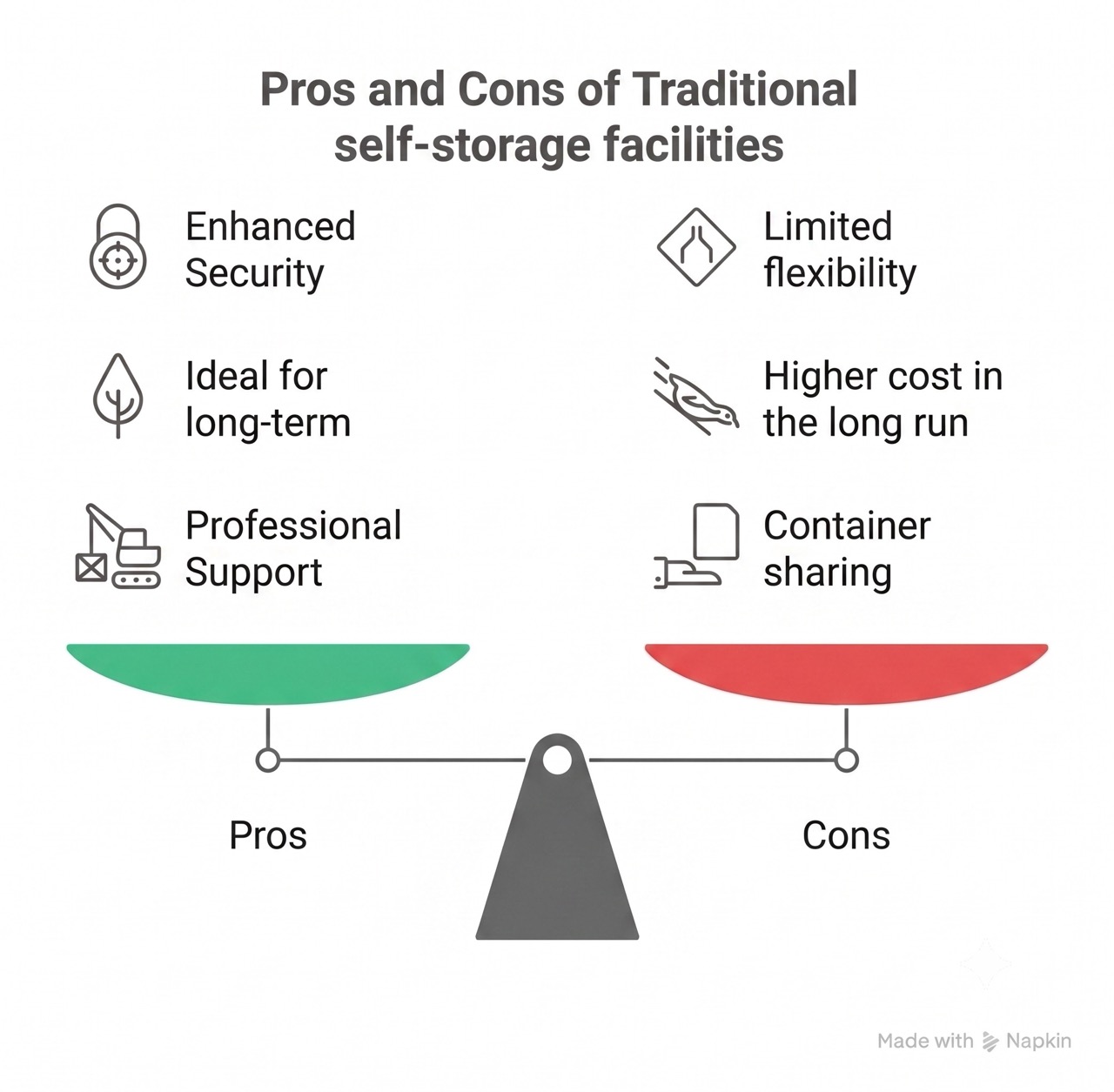
The advantages and disadvantages of a storage unit
Benefits
- Reinforced control (seals, surveillance, access control).
- Ideal for the long term.
- Professional support (movers, handling, insurance).
- Optimal protection thanks to ventilated wooden crates if available (absorbs humidity naturally).
Disadvantages
- Often in co-storage: you share the container with other people.
- Limited opening (no self-service).
- Less flexible than a self-storage unit.
- Often higher cost in the long term, depending on size and duration.
Why choose a traditional storage unit?
The traditional storage unit is therefore a safe and supervised storage solution, particularly suitable if:
- You are going abroad for several months or years.
- You are carrying out lengthy renovation work.
- You want to keep your furniture or archives in a closed, monitored and protected place.
On the other hand, if you are looking for flexibility, regular access or individualized storage, turn to solutions of Self-storage.
How to choose your storage unit?

Selecting a traditional storage unit should not be done lightly. Several criteria determine the quality of service and the preservation of your property.
Here's how to compare offers and find the right one storage best suited to your needs.
Essential criteria for selecting a storage unit
Before signing a contract, it is recommended to evaluate the following points:
| Criterion | What to check | Concrete example / Tip |
|---|---|---|
| Location | Proximity to your home or future accommodation | If you are moving to Paris, choose a center close to the future accommodation to limit transport and time. |
| Container size | Volume adapted to your goods and boxes | Studio of 25 m² → 8–10 m³; house of 100 m² → 30–40 m³. Too small = bulk, too large = unnecessary cost. |
| Budget | Monthly rate, handling fees and options | 6 month rental can cost 15–20% less per month than 1 month rental. Check options like insurance and packaging. |
| Accessibility conditions | Access by appointment, opening times, staff availability | Some centers can open on Saturday morning on request. Make sure staff can accommodate you when needed. |
| Safety and security | Warehouse status, monitoring, alarms, insurance | Choose sealed boxes, 24/7 video surveillance and contract with insurance against theft, fire, water damage. |
Proposed security measures
Safety is a key factor in choosing a storage unit. Points to check:
- Surveillance systems (cameras, controls, presence of guard).
- Intruder and fire alarms.
- Leaded wooden box to avoid any external manipulation.
- Insurance included or optional covering theft, fire, water damage.
Several specialist brands offer furniture storage solutions. Don’t hesitate to compare prices of course, but also the different criteria set out above.
Frequently asked questions about storage
What size box or crate should I choose for my storage?
The size depends on the volume of your belongings:
A 15 m² studio corresponds to approximately 8 m³.
A 40 m² T2 requires approximately 12 to 16 m³.
A 100 m² house often represents 30 to 40 m³.Use a volume simulator or seek advice from the specialist company before booking. A furnished T3 apartment often results in a 20 m³ container.
What equipment do you need to store your belongings?
To protect and preserve your property, equip yourself with:
Strong cardboard boxes (suitable for books and dishes).
Protective covers for mattresses, sofas, armchairs.
Pallets to elevate your belongings and limit humidity.
Labels and markers to identify your boxes.
Padlocks or seals provided by the service provider for added security.Invest in professional equipment (bubble wrap, reinforced adhesive tape) to avoid unpleasant surprises.
How to organize storage in a storage unit?
Good storage saves space and makes it easy to find your items:
Place heavy and bulky furniture at the bottom.
Store heavy boxes at the bottom, lighter ones on top.
Leave a traffic lane if you use several checkouts.
Pack fragile objects (mirrors, paintings, dishes) with bubble wrap.
Keep a detailed list of the contents of each box.Choose vertical storage for flat objects (mattress, mirrors, paintings).
Can you easily access your belongings during storage?
In a traditional storage facility, entry is generally by appointment and only during opening hours (often Monday to Friday).
Unlike self-storage, you cannot enter freely: a check is carried out by staff before any withdrawal.